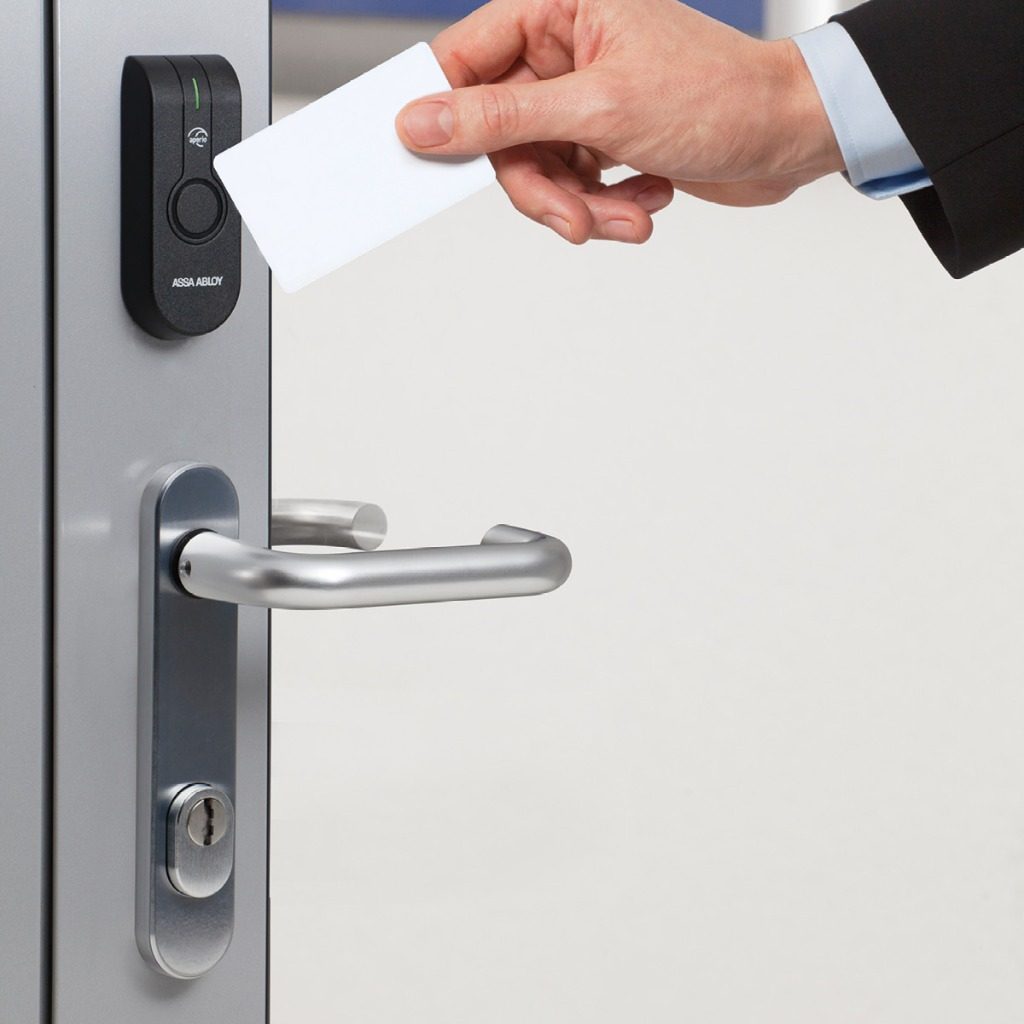
The pandemic accelerated a shift that was already under way: occupiers now expect to move through a building without touching a thing. Doors that open on approach, exit buttons you wave at rather than press and a phone that replaces the plastic access card are increasingly the baseline in premium commercial space, not a luxury.
What "touchless" actually covers
- Touch-free exit and automatic doors. Wave-to-exit sensors and automated door operators remove the shared push-plate at busy thresholds.
- Mobile credentials. A secure credential held on a smartphone, presented over Bluetooth or NFC, replaces or supplements the access card, issued and revoked remotely.
- QR and digital visitor passes. Visitors are pre-registered and arrive with a pass on their phone that opens speedgates or doors for the duration of their visit.
- Biometrics, where appropriate. Facial or other biometric recognition can remove the credential entirely for high-throughput or high-security areas, with the privacy considerations below.
Where it earns its keep
Beyond hygiene, the real gains are operational. Credentials issued to a phone mean far fewer lost cards, revocation in moments when someone leaves and a clear audit trail of where each credential was used. Touch-free flow keeps busy lobbies and lift lobbies moving. And because modern systems are IP-based, access control integrates naturally with the rest of the building, lift and destination control, visitor management, CCTV and intercom, so one credential and one set of rules govern the whole journey from street door to desk.
What to be careful about
- Cyber security. An IP access system is part of your network. It needs the same discipline as any other connected system, hardened devices, segmented networks and maintained firmware.
- Privacy. Biometric data is special-category personal data under UK GDPR. It can be the right tool, but it needs a clear lawful basis, proportionality and the right safeguards, it shouldn't be a default.
- Resilience. Touchless is convenient until it fails. Good design always includes safe fallback, fail-safe or fail-secure behaviour per door and a plan for power or network loss.
None of this is a reason to hold back, it's a reason to design properly. Touchless and mobile access deliver most when they're planned as part of an integrated system, not bolted on door-by-door.
How Antron approaches it
We design and install integrated access control with touch-free exits, mobile and card credentials, visitor management and lift integration, including projects such as 16 Old Bailey, where access control was integrated with high-level destination control and QR-enabled speedgates. It's all designed, installed and maintained by our own engineers.
Discuss your access control